
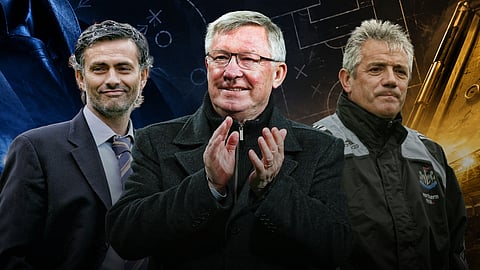
25 Best Premier League Managers of All Time Ranked

The Premier League has been home to some of the best football managers of all time since its formation in 1992.
Thirteen different bosses have lifted the Premier League in the last 34 years, with around 284 permanent appointments being made in that time.
The job of a manager has changed over the years, especially in England, with thorough coaching much more prevalent as clubs utilise other employees to focus on recruitment and commercial matters.
Managers are ultimately judged on success and silverware, which is the biggest factor we will consider in this list, as well as points-per-game ratios, amount of top-half PL finishes and cultural impact on the English game.
Here is Football Insider's definitive list of the best 25 Premier League managers of all time to date, based solely on their top flight achievements.
25. Sir Bobby Robson (Newcastle United)
A warm, immensely popular figure, Robson is remembered fondly by Newcastle fans for his five-year spell in charge between 1999 and 2004. He became part of his boyhood club for the first time in his 45 years in football and transformed their fortunes instantly.
The County Durham native led the Magpies to mid-table safety and gradually built a side that competed near the top of the Premier League for several seasons, finishing fourth, third and fifth in consecutive campaigns between 2001 and 2004. They were good to watch, too. With Robson in the dugout, there was always a sense that Newcastle were going places and he oversaw one of their best-ever teams.
24. Martin O'Neill (Leicester City, Aston Villa, Sunderland)
O'Neill is enjoying success as a manager to this day up at Celtic Park, and his PL achievements land him a spot on this list after he impressed at the helm of Leicester and Aston Villa. He quickly made the Foxes a force to be reckoned with after leading them to promotion in 1996.
Four consecutive top-half finishes followed their jump up to the top flight under the Northern Irishman. He left for Celtic in 2000 but was back in England with Villa in 2006. Another hugely impressive stint followed, as he helped the Second City club compete for Europe for three successive seasons. He is joint-12th in the all-time list of PL games managed.
23. Roy Hodgson (Blackburn, Fulham, Liverpool, West Brom, Crystal Palace, Watford)
An all-time Premier League managerial great, Hodgson was never among the elite, but he deserves the utmost respect all the same. The 79-year-old sits eighth in the list of most games managed in the competition, having been in the hot seat at six different clubs. Not bad for someone who spent so long working overseas and learning his trade in a football era when Englishmen really didn't travel well.
Hodgson's teams rarely lifted you off your seat but they were always well drilled and mighty hard to beat. His finest hour arguably came as he led Fulham to a seventh-placed finish in 2008-09. He also led Blackburn and West Brom to respective top-half finishes and allowed a Crystal Palace side brimming with talent to play some great football between 2017 and 2024.
22. Unai Emery (Arsenal, Aston Villa)
The first of the few current Premier League bosses on this list is Basque genius Emery. He has revolutionised Villa in the last few seasons, leading them back to the biggest club competition in world football with two fourth-place finishes in the last three seasons.
His job has been made even tougher by financial constraints, but, like the very best, the 54-year-old has always found a way. A tough spell at Arsenal, as the first post-Wenger manager, has now long been forgotten. He is regarded as one of the best pound-for-pound managers in the world, and could rise up this list in the years to come. Villa are lucky to have him.
21. Brendan Rodgers (Swansea, Liverpool, Leicester)
Rodgers' eccentricity made him one of the most divisive and interesting figures in the top flight, particularly during his spell as Liverpool boss. He came mightily close to winning the Premier League there with a thrilling Luis Suarez-led attack that tore opponents apart before the infamous Steven Gerrard slip and Selhurst Park capitulation cost the Reds.
The Northern Irishman had first consolidated Swansea in the Premier League after promotion in 2011, then, after Anfield and Celtic, he also guided Leicester to consecutive fifth-place finishes and made them one of the best teams to watch in the top flight for a period around 2019 to 2021. Nevertheless, there is a sense that Rodgers could and should have achieved more, given his coaching ideas and leadership skills.
20. Sam Allardyce (Bolton, Newcastle, Blackburn, West Ham, Sunderland, Crystal Palace, Everton, West Brom, Leeds)
Yes, you are reading that right. Allardyce managed nine different Premier League clubs across a 22-year period, landing himself fifth in the all-time list of games managed in the competition. He is an icon of the English game, whether the masses like it or not.
While often viewed as an old-school manager due to his teams' emphasis on physicality and long balls, Allardyce was revolutionary in his early years at Bolton, becoming one of the first managers on these shores to embrace sports science and data analysis. He took the Trotters to four consecutive top-eight finishes and was never relegated with a full season in charge of a club. Never unaware of his managerial smarts, Allardyce loved nothing more than a giantkilling and upsetting the big guns. He was at his most effective when the elite were in town and turned up fearing a bruising battle. They always got one.
19. Kevin Keegan (Newcastle, Man City)
Keegan's legendary rallying call of an interview after Newcastle's April 1996 win over Leeds is enough to land him on this list alone. The Magpies ultimately fell short that season as Man United pipped his side to the league title by four points. But what great joy his team spread, never especially well drilled but full of watchable talents who loved to show how good they were.
He had already taken Newcastle to third and sixth place in previous seasons, and to this day is viewed as a hero on Tyneside. Keegan also guided Man City back to the top flight in 2002, establishing them as a regular in the division in the next three years before Middle Eastern riches later took them to another level. Keegan's legacy is that his sides made football more fun. Exactly how it should be.
18. Gerard Houllier (Liverpool, Aston Villa)
Houllier is, perhaps, underrated by many modern-day supporters who fail to realise just the impact he had at Liverpool, which was felt long after his departure. The charismatic Frenchman changed the culture at Anfield, easing out the drinkers and bringing in a better focus on discipline both on and off the pitch. His best achievements came away from the Premier League, no doubt, but he still led the club to five successive top-five berths between 1999 and 2004, including second spot in 2001-02.
The Frenchman also played a key role in developing and guiding some of the club's biggest legends, like Steven Gerrard, Jamie Carragher and Sami Hyypia, as well as Ballon d'Or winner Michael Owen. His counter-attacking style was a bit one dimensional and Houllier's teams pale in comparison with the great Man United and Arsenal sides of the time, but Liverpool were always competitive under the former teacher's astute and warm tutorship.
17. Rafael Benitez (Liverpool, Chelsea, Everton, Newcastle)
Houllier's replacement at Liverpool comes in just ahead of him, with Benitez boasting a slightly better points-per-game record in the top flight and more success at other clubs too. He built on the Frenchman's legacy at Anfield with bigger success in Europe - the most memorable Champions League win of them all in 2005 as well as a runners-up spot two years later - two third-place finishes and a second place in 2008-09.
The Spaniard was certainly not afraid to ruffle some feathers in his time at Liverpool, which only endeared him even more to the club's supporters. Like Houllier, his teams were usually set up to contain the opposition rather than blow them away. But he achieved some notable successes and his teams were always tough to play against. Benitez also had another successful, yet short, interim spell coming at Chelsea in 2013 before being far more warmly welcomed at Newcastle, who he consolidated back in the top flight after promotion in 2017. Benitez was a master tactician in his prime and could have had a title to his name had some fine margins gone his way.
16. Harry Redknapp (West Ham, Portsmouth, Southampton, Tottenham, QPR)
Redknapp's charismatic, astute style of management, which saw him oversee five clubs across 19 different Premier League seasons, sees him rank above some real heavyweights on this list. He was rarely less than great value when presented with a microphone or a television camera, and his famous window-down interviews while leaving the training ground in his SUV many deadline days a lot more fun.
The 79-year-old may have been old-school and preferred experienced players to callow youth, but he also knew what he was doing. He produced the goods and got results in the hot seat pretty much everywhere he went. First, he made West Ham compete around mid-table for seven seasons, then guided Pompey to the same level twice over, and also took Spurs back to the Champions League while winning a Premier League Manager of the Season award. Redknapp had staying power, too. He sits fourth on the all-time list of games managed in the competition.
15. Mauricio Pochettino (Southampton, Tottenham, Chelsea)
Pochettino's Premier League career is surely not over, so there is more time for him to rank even higher on this list. For now, he is 15th, following impressive spells at the helm of Southampton and nearly-but-not-quite Tottenham, who he took to a Champions League final and nearly to a league title.
The Argentine boss transformed the Saints with an attractive, high-pressing style that saw them finish eighth in 2013-14. He then made Spurs perennial title challengers, as they came third, second and third respectively between 2015 and 2018. Only four other Premier League managers ever have been quicker than Pochettino to 100 wins with one team, and he boasts the best points per game (1.77) in the division of any manager on this list so far. He was at his best developing young talents and the stunning rises of Harry Kane, Dele Alli, Kyle Walker and co. under his leadership speaks volumes about his coaching ability.
14. David Moyes (Everton, Man United, Sunderland, West Ham)
Moyes is the greatest manager in Premier League history never to win the title, when longevity, records and impact are all accounted for. Only two men have managed more games in the competition than the Scot's 760 over the last 24 years.
The gimlet-eyed Glaswegian is a master of marshalling his resources and getting the best out of what he has got. He steered Everton to nine top-eight finishes in 12 seasons at Goodison Park, including their highest-ever Premier League placing of fourth in 2004-05, with a budget dwarfed by his rivals. Despite struggling to follow his Fergieness at Man United, he bounced back to impress at West Ham domestically and guided them to their first trophy win in 43 years. He remains one of the most respected bosses in the division to this day, with Everton making an impressive start to the 2026-27 campaign.
13. Arne Slot (Liverpool)
While some may question the decision to place Slot so high, he is ultimately one of just 13 managers in the history of the competition to reign supreme across a single campaign. That alone means he deserves a placing so high, even if he left Liverpool under a cloud at the end of 2025-26 after a dreadful second season.
The Dutchman did not just guide Liverpool to the title in 2024-25, they ran away with it and had the trophy virtually in the bag by the end of January. He introduced more control to their play without quite the same eyepopping excitement as under his predecessor but Slot coaxed the best season of his career out of Mohamed Salah and their 10-point victory margin was emphatic. Liverpool scored two or more goals in the most Premier League matches ever across a single season as Slot became the first Dutch boss to lift the title. It all ended in ugly fashion a year later following a bruising fall-out with Salah, but he achieved what plenty of Anfield managers over the years could not.
12. Manuel Pellegrini (Man City, West Ham)
Pellegrini also won the Premier League in his debut season, this time at Man City, as they overtook Rodgers’ Reds late in 2013-14 and he became the first non-European boss to lift silverware in the competition. The Citizens also broke the record for the most goals scored (156) in a single campaign in all competitions by an English top flight club. He then picked up a runners-up medal in 2014-15 and took City to fourth in the following season, boasting an impressive 61.4 per cent win rate in league games across those three campaigns, establishing the foundations for the success that followed.
Utterly uninterested in the limelight or speaking in media-friendly soundbites, Pellegrini lacked the ego of some of the other City managers of the Abu Dhabi era, but he was a shrewd hand at the tiller. The sense when he was in charge was that it was all about the players. He had some pretty great ones, for sure, but the Chilean was smart enough to let them do their thing.
11. Carlo Ancelotti (Chelsea, Everton)
Ancelotti’s Chelsea were an unstoppable force in 2009-10, as he guided the club to their third Premier League title with the most goals (103) ever scored, the best goal difference (+71) and the most home goals (68) ever scored in a single season in the competition at that time.
The legendary Italian maximised the output of Didier Drogba and Frank Lampard, leading the Blues to second place in the next campaign too. He also enjoyed a fruitful spell at Everton, achieving the highest points per game ratio (1.53) of any permanent Toffees boss in the PL era and proving a hugely popular figure on Merseyside.
10. Antonio Conte (Chelsea)
Conte produced possibly the best and most iconic tactical adjustment in the competition's history when he switched Chelsea to a 3-4-3 formation in the early months of the 2016-17 campaign after a tough start, and they subsequently romped to the title with 93 points and broke the record for wins in a 38-game season, with 30. His use of wing-backs and a high-pressing style was the first of its kind to produce such success in the top flight of England.
Conte’s brash character and manic touchline presence always made for great entertainment, and he was unafraid of questioning his paymasters in the quest for more points and wins. He also oversaw three other strong seasons with Chelsea and made Tottenham hard to beat, if not loveable. But then Conte has always been about getting the job done rather than just looking good.
9. Kenny Dalglish (Liverpool, Blackburn, Newcastle)
After achieving huge success as Liverpool boss before 1992, Scottish icon Dalglish headed into the Premier League as Blackburn manager, and went on to create even more history. Aided by Jack Walker’s wealth, he built a title-winning side from scratch and achieved greatness in 1995 as Alan Shearer and Chris Sutton devastated defences across the country.
Dalglish’s achievement remains one of the impressive in English football history, with Rovers becoming one of the world’s best sides across a three-season period under his guidance not long after being promoted. He did a stellar job at Newcastle, too, before a romantic late-career return to Anfield after 10 years out of management in 2010. It ended with a bit of a whimper but Dalglish got Liverpool playing again after some grim months under Hodgson. He was always there when his beloved Reds needed him.
8. Mikel Arteta (Arsenal)
Arteta is on his way to becoming an all-time great in Premier League manager terms. He was often doubted in his first few seasons at the Emirates, but is now untouchable and has an astonishing £25million-a-year contract to prove it after their 2025-26 title success.
The size and success of the Spaniard’s rebuild in North London cannot be understated. He has not only built a squad capable of steamrolling opponents, but also looks to have refreshed the widespread tactical approach across the country, with teams following Arsenal’s lead as they prioritise a physical spine of the team, strength at set-pieces and utilisation of centre-backs on the flanks. It is not always sexy but it is mighty tough to play against and Arsenal are a team to be feared again.
7. Claudio Ranieri (Chelsea, Leicester, Fulham, Watford)
Leicester’s 2015-16 Premier League title win is regarded as the greatest success story in English football history, and one of the biggest shocks of all time in sports as a whole. Ranieri was the mastermind behind that triumph, so he deserves his place above some real big-hitters on this list.
His good-humoured, gentlemanly persona was the ideal catalyst to the Foxes’ success, as he shaped a team of misfits into a title-winning side full of players who came good at a time when all the big guns had a fallow period. The Italian used the 4-4-2 formation to its best effect, and his shrewd man-management allowed the players to keep their cool and romp home as a scarcely believing football world held its breath. He also came close to winning the title at Chelsea in 2004, finishing second behind the unstoppable Arsenal invincible team.
6. Roberto Mancini (Man City)
Mancini boasts the fourth-highest points per game ratio (2.05) of any manager with over 50 games at the helm in the Premier League. He was the first man to lead City to title glory, with that famous Sergio Aguero goal clinching it in 2011-12, and his sides were always well constructed and highly watchable. He guided the club to third and second place either side of that memorable campaign, and even if City's rule-breaking sheds a different light on how the squad was built, there is no denying they were the best team at the time.
Mancini had an aura that came from a lifetime of being a football great and, while he could be petulant and difficult, as well as egocentric, he was loveable, too, and his management of the wayward Mario Balotelli was box office. The Italian is undoubtedly one of the most significant bosses in the history of the competition, despite lacking the longevity of others.
5. Jose Mourinho (Chelsea, Man United, Tottenham)
The ‘Special One’ comes in at fifth, which he is unlikely to agree with given his thinly-veiled appreciation of his own achievements. His status as a Premier League managerial great is defined by the back-to-back successes he enjoyed in the mid-2000s at Chelsea. Mourinho talked the talk at Stamford Bridge, but he walked it too, creating a dominant side that powered their way to two titles between 2004 and 2006, picking up 186 points in the process. That granite-hewn side could sometimes be a tough watch, but once they went ahead there was almost no clawing them back.
He was one of the first real maverick managers from overseas, and remains the youngest to ever lift the Premier League title at 42 years old. More success followed in a second spell at Chelsea as they won the 2014-15 crown under his guidance too, while he is widely regarded as the best Man United boss of their recent down years, taking them to second place in 2017-18. A less successful spell came later at Tottenham but there is a sense with Mourinho, football obsessive that he is, feels he still has something to prove in English football and his race in this country may not quite yet be run.
4. Arsene Wenger (Arsenal)
Wenger built the only invincible side of the Premier League era to date at Arsenal, and changed how many in England viewed the game altogether. His success shifted the perception of foreign managers, while new attitudes towards training and nutrition, as well as attacking tactics, were borne from his proven methods. Chips and ketchup were off the menu, and dazzling football played at a level rarely seen before in English football was on it.
The Frenchman had staying power, too, saying he never intended to build a dynasty and then somehow staying for more than two decades. Remarkably, he has overseen more matches than any other manager in the Premier League, with 828 between 1996 and 2018. Three titles to his name also rank him joint-third on the list of winners. Arsenal did not finish below fourth in any of his first 20 seasons in charge, and although the last few years were tricky as a demanding supporter base ached for more trophies, Wenger's legacy as a trailblazer and all-time great remains fully intact.
3. Jurgen Klopp (Liverpool)
Liverpool had never won the Premier League before 2015, and had failed to finish above fifth in five of the previous seven seasons. Klopp arrived, he saw and he conquered in a blitz of brilliant football, bombastic interviews and mesmeric touchline presence. Has there ever been a more charismatic Premier League manager? Klopp delivered Liverpool's first Premier League title in 2020, clinched in record time with seven games left to play, but there would have been many more were it not for a Man City side that cheated the financial rules to just about keep their huge rivals at bay. To secure 97 points and 92 points and finish second, as Liverpool did while City bent the rules, fully justifies their German manger's place in this list's top three.
But it was never about the numbers with Klopp. Or the data. His teams, built on gegenpressing and a heavy-metal intensity that was as exhausting to watch as it was mesmerising, were inspired by raw emotion and their manager was a genius at using their support to dredge extra metres out of his players' legs. There was a period when Liverpool, despite operating on a self-sustainable budget lower than their rivals and without state-funded or oil wealth, were the best team in the world. Klopp was the pied pier who many everyone believe.
2. Pep Guardiola (Man City)
Guardiola’s era-defining stint in charge of Man City is the greatest show of dominance by a manager in Premier League history over 10 seasons. City won six titles in seven years with him in charge, either side of a slow start and end to his reign at the Etihad. The Spaniard completely reshaped English football, not just the Premier League, forever, with the club reaching unforeseen heights and his tactics being adopted across the country at all levels of the game. Guardiola’s undying determination to win and constant evolution of his philosophy made City a near-unstoppable force for so long that even their own fans almost became too accustomed to them winning.
While City's guilt for breaching financial rules has slightly stained his legacy, Guardiola's status as a tactical genius, perhaps the greatest ever seen on these shores, is without question. Some will question how much of their success came down to extensive financial resources being illegitimately available, but nothing can take away from how the intense, obsessive and sharply-dressed Spaniard shaped and dominated the best league in the world for so long.
1. Sir Alex Ferguson (Man United)
Ferguson is the undisputed Godfather and takes top spot as the best Premier League manager of all time for building and maintaining a true dynasty. Guardiola himself called the Scot the “greatest in this country” in a May 2026 interview, such is the magnitude of his achievements in the game. Ferguson holds more records in the competition than anyone else, not least the most titles (13), most wins (528) and manager of the season awards (11).
The Man United titan sets the benchmark for longevity and continued success across the world of football, not just in England. Their downfall since his departure is perhaps the best testament to just how much his influence held weight at Old Trafford and beyond. Unlike so many great managers, Ferguson’s greatest strength was that he adapted tactics to the players at his disposal, rather than shape teams to a set style over his 26 years in charge.
He ruled by fear - woe betide any journalist who crossed him - in an era when a manager could spray his players and they would dutifully listen. The "hairdryer" treatment was a renowned device that he would summon when required. But Ferguson did not become the best by authority alone. He adapted, he tweaked, he reinvented, regularly changing his number two and coaching staff to keep players on their toes and adapt to ever-changing tactics. He saw off all his rivals over the years, from Dalglish and Keegan in the early Premier League years to Mourinho and Wenger later on, outlasting them and ultimately outdoing them. For that, he stands tall as the greatest.