


This is what ‘surprised’ ex-refs chief after Maxence Lacroix red card vs Man United


Chris Kavanagh was far from convincing during a contentious incident involving Maxence Lacroix against Man United at Old Trafford.
That is according to former PGMOL chief and ex-FIFA referee, Keith Hackett, who exclusively told Football Insider that the referee never looked like reaching the correct conclusion on Sunday, 1 March.
The Crystal Palace star, who had opened the scoring after just four minutes, was sent off in the second half after bringing down Matheus Cunha right on the line of Man United‘s penalty area.
Unsurprisingly, the Premier League official’s decision was heavily debated, especially after Kavanagh failed to award a red card immediately and depended on a VAR review not to make a mistake.
⚽ Man United Matchday ⚽
Team news, line-ups, expert previews and tactical analysis for every Manchester United fixture.
VISIT THE MATCH HUBWhat have football fans misunderstood after Maxence Lacroix was sent off?
A lot of talk was about the “double jeopardy” rule, but that only comes into effect when the player committing the foul makes a real attempt to play the ball.
In Lacroix‘s case, there was no attempt to play the ball, and with no covering defenders, the referee was well within his rights to show a straight red card to the experienced centre-back.
Cunha was also accused of diving, and while this is far more subjective, players are going down under less pressure now due to officials not giving the decisions in their favour unless they do.
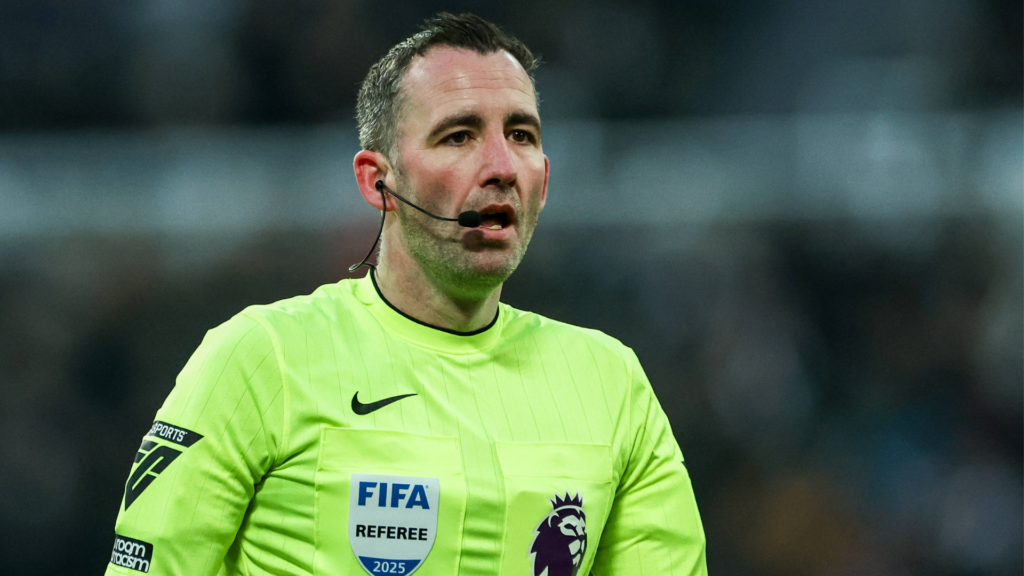
Hackett believes wholeheartedly that it was a simple penalty decision to make at Old Trafford, with the length of time needed to reach that conclusion coming as the most baffling moment.
Chris Kavanagh causes disbelief over Man United-Crystal Palace controversy
Speaking exclusively to Football Insider, the former referee said: “If you commit an offence outside the penalty area and continue it into the area, it’s a penalty kick.
“A lot of people forget that the line counts as inside the area as well. The holding is sustained. Why is the defender maintaining his arm and hand on his opponent?
“That’s where the problem lies, not with Cunha going to ground. The reason behind Cunha and players like him going to ground is that, with holding offences, players are exaggerating the falls to show an offence has taken place.
“That’s where the referee has to make a judgment over whether it’s an act of simulation. On this occasion, the contact was sufficient for him to go down.
“What surprised me was that the referee needed VAR. In the process of awarding a penalty kick, I don’t think he considered DOGSO. That surprised me because, once he gives a penalty, it fulfils DOGSO. He’s going towards goal, and there are no covering defenders. It’s nailed on.”
Don’t Miss a Beat: Your Man United Insider Access
Get the full story from Old Trafford and Carrington with our dedicated expert hubs:
Updated 24/7 with expert analysis from the heart of Old Trafford.